


Private Collection
The original work shown here is no longer available.
A new work featuring the same words or theme may be commissioned upon request. As each work is created by hand, every piece is unique.
A Conversation with Mohri Suzuki
In this Journal, we sit down with Mohri Suzuki to explore calligraphy through his own experiences and reflections.
Q. Is there a work of calligraphy that has stayed with you?
Several years ago, I encountered a work of calligraphy by Saneatsu Mushanokoji at the Tokyo Memorial Museum in Sengawa.
I was going through a difficult period in my life at the time. When I stood in front of his handwritten words, tears suddenly came
to my eyes.
I wasn’t trying to understand or analyze the work. I simply felt as though someone was saying to me, You’ll be all right.
Afterward, I felt strangely calm — and happy.
Q. What was it about the work that moved you?
It wasn’t only the meaning of the words.
The fact that they had been written by his own hand was important to me.
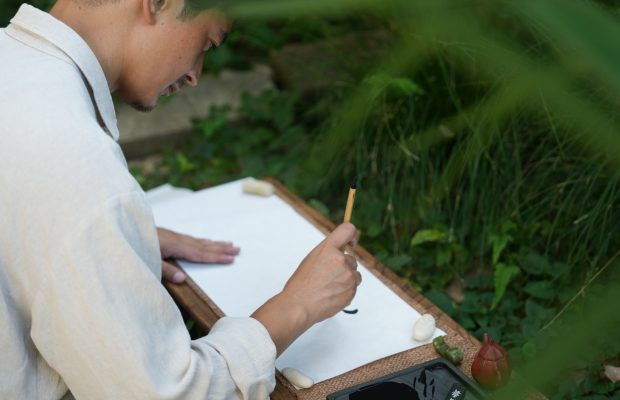
Looking at the movement of the brush, I felt the presence of the person who had once stood in front of the paper. It was almost as though I were receiving a message directly from him, across time.
That experience made me realize that handwriting can carry something beyond the meaning of words.
Q. Is writing beautifully the same as writing good calligraphy?
I don’t think they are necessarily the same.
What we call “beautiful” is different for each person. The same is true of what we consider good or bad calligraphy.
For me, one important principle is to write with care and not destroy the meaning of the words.
But there are also things that words alone cannot express.
With a brush, something that has not become language yet can appear in the line — a feeling, an atmosphere, a rhythm.
That is part of what I find interesting about calligraphy.
Q. How would you suggest looking at calligraphy?
If a piece catches your attention, you don’t necessarily have to begin by asking what the characters mean.
Try following the movement of the brush with your eyes.
You can even trace the movement in the air with your hand.
There are traces of the person in the line — strength, rhythm, pauses, breath.
Sometimes you can sense these things even if you cannot read the characters.
Where did the brush move quickly?
Where did it slow down?
Where did the writer breathe?
Perhaps this is another way of reading calligraphy.
You are not only reading the words. You are following the movement of the person who wrote them.
Q. Why do you continue to write words that have moved you?
Because I was moved by them myself.
When I encounter words that give me something — courage, reassurance, or a different way of seeing things — I want to carry them forward through my own writing.
Some words don’t belong to a particular season or moment. You can encounter them at different times in your life and receive something different from them each time.
That is why I return to certain words and write them again.
Perhaps calligraphy doesn’t have to communicate the same thing to everyone.
Sometimes a work simply waits for the person who needs to see it.
— Mohri Suzuki
※日本語解釈
筆の呼吸をたどる 鈴木猛利との対話このJournalでは、鈴木猛利への問いかけを通して、自身の経験や書に対する考えを聞いていきます。
Q. 心に残っている書との出会いはありますか?
数年前、仙川の東京記念館で、武者小路実篤の書に出会いました。
その頃の私は、悩みの多い時期にいました。その肉筆の言葉の前に立ったとき、突然、涙が出てきました。
作品を理解しよう、分析しようとしていたわけではありません。ただ、「大丈夫だよ」と言ってもらったような気がしたのです。
そのあと、不思議と冷静になり、そして嬉しい気持ちになりました。
Q. その書の何が、そこまで心を動かしたのでしょうか?
言葉の意味だけではなかったと思います。
本人の手によって書かれた「肉筆」であることが、私にとって大きな意味を持っていました。
筆の動きを見ていると、かつてその紙の前に立っていた人の存在を感じるようでした。時間を越えて、本人から直接メッセージを受け取ったような感覚です。
この経験から、手で書かれた文字には、言葉の意味を超えて伝わるものがあるのだと思うようになりました。
Q. 「美しく書くこと」と「良い書を書くこと」は同じでしょうか?
必ずしも同じではないと思います。
何を「美しい」と感じるかは人によって違います。書の良し悪しについても同じです。
私が大切にしている一つの軸は、丁寧に書くこと。そして、言葉の持つ意味を壊さないように書くことです。
でも、言葉だけでは表現できないものもあります。
まだ言葉になっていない感覚や雰囲気、リズムのようなものが、筆を通すことで線に現れる。
そこが、書の面白さの一つだと思っています。
Q. 書は、どのように見ればいいのでしょう?
気になる書に出会ったら、最初から「何と書いてあるのだろう」と考えなくてもいいと思います。
まず、筆の動きを目でなぞってみる。
自分の手で、空中になぞってみてもいい。
線には、書いた人の跡があります。強さ、リズム、間、呼吸。
文字を読むことができなくても、それを感じ取れることがあります。
どこで筆が速く動いたのか。
どこでゆっくりになったのか。
どこで息をしたのか。それも、書を「読む」一つの方法なのかもしれません。
文字だけではなく、それを書いた人の動きをたどってみるのです。
Q. 心を動かされた言葉を、なぜ自分でも書き続けるのでしょうか?
自分自身が、その言葉に感動したからです。
勇気をもらったり、安心したり、ものの見方が少し変わったり。そういうものを言葉から受け取ったとき、今度は自分の書を通して、それを受け継いでいきたいと思います。
季節や特定の瞬間に限定されない言葉もあります。人生の違う時期にもう一度出会えば、そこからまた違うものを受け取ることができる。
だから私は、ある言葉に何度も戻り、繰り返し書くのだと思います。
書は、すべての人に同じことを伝えなくてもいいのかもしれません。
時には、その書を必要としている人が現れるのを、静かに待っているような。
— 鈴木猛利


Comment